
The AgEnRes Modelling Toolbox: connecting farm decisions, regional change, markets and energy systems
What happens to European agriculture when energy prices rise sharply? The answer depends on where we look.
At farm level, higher fuel and fertiliser prices may change production, investment and technology choices. Across a region, farms may respond differently depending on their size, specialisation and capacity to invest. At market level, these responses may affect production, land use, prices and trade. At the same time, the energy system continues to evolve through changes in fuel supply, technologies and climate policy.
Fully understanding the links and processes of such a complex system is something that no single model can represent in sufficient detail. For this reason, AgEnRes is developing an integrated modelling toolbox that brings together models operating at different scales, aiming to connect information about decisions of the farmer and his farm with technologies, structural change, regional dynamics, agricultural markets and the wider energy system.
Although the toolbox is still under development, we can already advance that its value will not come simply from placing several models next to each other, but from determining which information should move between them, how it should be translated, and what can be learned from examining the same transition across several scales.
At this point, you might be wondering, how is this toolbox any different from other modelling solutions? Well, the AgEnRes Toolbox is, of course, being designed to generate a tangible and positive impact at both farm and policy level by tackling some of the key challenges in the sector. One of these challenges is the so-called “micro-macro gap”, which refers the difficulty of connecting detailed decisions made by individual actors with outcomes observed at regional, sectoral or economy-wide level, which is particularly relevant for policy modelling.
At the micro level, a farm might decide whether to adopt precision fertilisation, reduce tillage, purchase new machinery or adjust its production plan. That decision depends on farm-specific factors such as land, livestock, labour, current machinery, input prices and investment capacity.
Moving directly from one representative farm to a European-wide conclusion can overlook farm diversity, land competition, adoption constraints and market feedback. Conversely, starting only from an aggregate model may hide the technical and economic conditions determining whether a technology is viable at farm level.
At broader scales, policymakers need to understand:
- how many farms may adopt the technology;
- which types of farms benefit;
- whether non-adopters contract or exit;
- how land use and agricultural production change;
- whether commodity prices and trade respond;
- whether fossil-energy dependence genuinely declines; and
- what happens to emissions, income and other policy objectives.
So where do we start from?
The current architecture of the toolbox is based on soft linkages, meaning that the models retain their own structures and are not forced into one fully coupled system.
Even though at first glance a fully coupled model may appear more integrated, it can also become difficult to interpret, validate and maintain. To avoid this, the soft linkages allow our toolbox to use selected outputs from one model that are then translated into parameters, constraints, assumptions or scenario drivers that another model can use. This presents several advantages, including:
- Each model remains focused on the questions it was designed to answer.
- Relevant outputs are selected rather than transferred indiscriminately.
- Translation steps can be documented and reviewed.
- Differences between model results can reveal uncertainty or structural assumptions.
- Individual models and linkages can be improved without rebuilding the entire system.
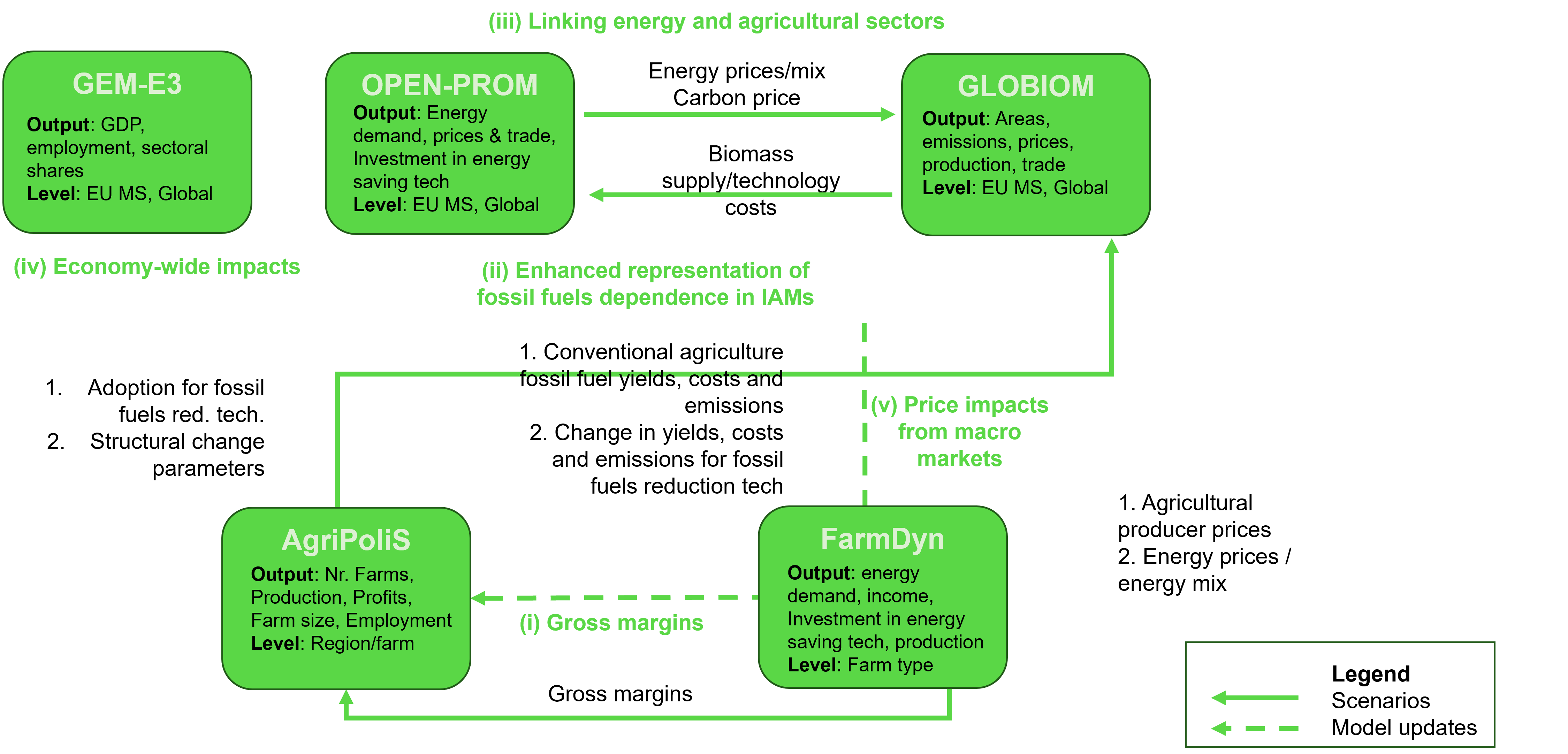
Up to this point we have been discussing more technical and theory-focused aspects of the toolbox, but I think it’s time we meet the real protagonists of this story, the models, their individual roles and how they connect to each other. In practical terms, a simplified interaction chain in the AgEnRes toolbox can look something like this:
- OPENPROM: the energy-system context - OPENPROM supplies the wider energy-system perspective, including scenarios for energy demand, supply, prices, fuel mixes and emissions. It can examine crude oil price shocks, energy prices, fuel consumption, changes in the energy mix and the effects of climate-policy scenarios. In AgEnRes, its energy-price projections can be passed to land-based and farm-level models.
- FarmDyn: the individual farm decision - FarmDyn examines production, investment, energy use and technology choices at individual farm level. It can investigate how a farm responds to technologies, changing input prices and policy conditions. It produces detailed evidence on investment costs, diesel and fertiliser use, labour, yields, profit and emissions.
- AgriPoliS: adoption and structural change - AgriPoliS represents heterogeneous farms interacting through land and product markets, allowing regional structural change to emerge over time. It can take technology parameters from FarmDyn and price or market signals from GLOBIOM. It then simulates how heterogeneous farms adopt technologies, compete for land, expand, contract or leave farming over time.
- GLOBIOM: agricultural markets and sector-wide scenarios - GLOBIOM can translate selected evidence from FarmDyn, AgriPoliS, OPENPROM and other AgEnRes work packages into costs, technology parameters, adoption constraints and scenario drivers. It can then assess consequences for production, land use, prices, trade, fossil-energy dependence and emissions.
- GEM-E3: the wider economic perspective - Finally, GEM-E3 can add a macroeconomic layer, examining interactions between the economy, energy markets, sectoral activity and environmental policies.
The perspectives that these models bring together can then help us answer questions like:
- How do crude oil and energy-price shocks affect agricultural input costs and fuel use?
- Which farms are technically and economically able to adopt energy-saving technologies?
- How might adoption differ among farm types and regions?
- Could technology support alter farm size, land competition or structural change?
- Do farm-level energy savings remain significant when scaled across agricultural markets?
- Could changes in production, trade or land use create unintended effects?
- Which policy pathways strengthen resilience without creating unacceptable economic or environmental trade-offs?
These are ex-ante questions. Of course, the toolbox does not claim to predict one inevitable future, but it helps compare internally consistent scenarios and examine how results change under different assumptions.
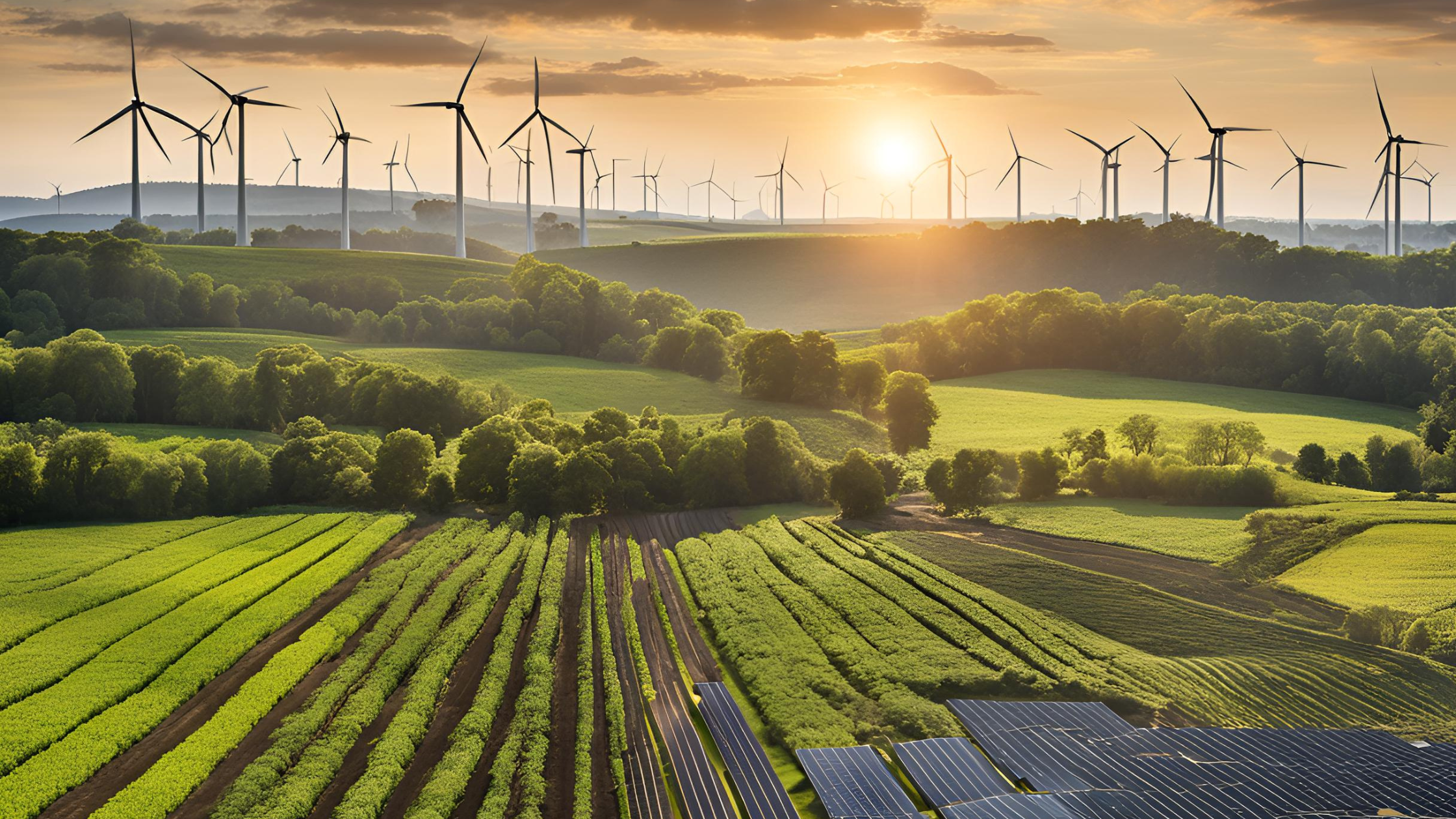
This article opens a new AgEnRes series exploring the models being connected through the toolbox. Over the course of this series, we will show how the different parts fit together and invite modellers, policymakers and agricultural experts to challenge the assumptions, identify gaps and contribute to the discussion.
Until our next episode, we ask you: which part of the modelling chain do you find most difficult to connect: energy systems, farm decisions, regional dynamics, agricultural markets or the wider economy?